Why Does Tinnitus Feel Louder When You’re Anxious?
Tinnitus anxiety is driven by a hypervigilance loop in which the brain’s amygdala tags the tinnitus signal as a threat, actively amplifying the phantom sound and generating more anxiety. A neuroimaging study found that the strength of this amygdala-to-auditory-cortex connection correlates directly with tinnitus distress severity (Chen et al. (2017)). This means tinnitus distress is determined by the brain’s reaction to the sound, not its volume, and understanding the loop is the first step to breaking it.
If you have noticed that your tinnitus seems to get louder, more intrusive, or harder to push aside on days when you are stressed or anxious, you are not imagining it. Something real is happening in your brain. And if someone has told you to “just ignore it” — and you found that completely impossible — there is a neurological reason for that too.
Many people live with tinnitus without it dominating their lives. Others find themselves trapped in a cycle where the sound and the anxiety about the sound feed each other relentlessly. This article explains exactly why that happens: the specific mechanism behind the loop, why willpower alone cannot override it, and what the evidence says about breaking it for good.
The Tinnitus Anxiety Loop: What’s Actually Happening in Your Brain
Think of your amygdala as the brain’s threat-detection system. Its job is to scan incoming signals and flag anything that might mean danger. Under normal circumstances, tinnitus is an unfamiliar, persistent, internally generated sound — exactly the kind of signal the amygdala is primed to treat with suspicion.
Once the amygdala decides the tinnitus signal is a threat, it does not simply generate a feeling of unease and wait. It sends active excitatory signals directly to the auditory cortex, the part of the brain that processes sound. Those signals physically amplify the phantom percept — the ringing or buzzing becomes louder and harder to ignore. A neuroimaging study using Granger causality analysis in 26 people with chronic tinnitus found that the strength of this connectivity, directed from the amygdala to the auditory cortex, correlated directly with tinnitus distress severity (Chen et al. (2017)). The correlation on the left side was r=0.570 — a strong relationship for a neuroimaging finding.
The amplified signal then feeds straight back into the threat-detection cycle. A louder, more insistent sound confirms to the amygdala that something is wrong. Anxiety rises. The amygdala responds with more excitatory signals. The loop closes.
Over time, this becomes a conditioned reflex. The amygdala has learned to treat tinnitus as a threat, and it activates automatically — below the level of conscious control. This is why telling yourself “it is not dangerous, just ignore it” rarely works. You are trying to override a trained limbic response with a verbal instruction, and the limbic system does not work that way.
Tinnitus loudness is a poor predictor of distress. Two people with identical audiograms and identical tinnitus frequencies can have completely different outcomes, depending entirely on whether this loop has formed. The sound is not the problem — the brain’s relationship to the sound is.
This insight is supported by clinical observation going back to the conditioned emotional response model documented by Baguley et al. (2013) in the Lancet. Roughly 1 in 5 people with tinnitus develop significant distress, and distress levels correlate poorly with the acoustic properties of the sound. The difference lies in whether the hypervigilance loop has taken hold.
Howard, a tinnitus patient quoted by Tinnitus UK, describes exactly this process forming in real time: “I started researching online and that’s when the panic really set in. I became hyper aware of the sound and completely unable to ignore it.” The cognitive, emotional, and physiological channels all activated at once — and the loop locked in.
Three Channels That Keep the Loop Running
The hypervigilance loop does not sustain itself through one mechanism alone. It runs through three distinct channels, each reinforcing the others. Targeting just one while ignoring the rest is why approaches like “just relax” tend to fail.
The emotional channel is the most immediately recognisable. Anxiety, irritability, and a creeping sense of helplessness are all expressions of sustained limbic activation. The amygdala is running on high alert, and the emotional fallout is constant. This is not a character flaw or an overreaction — it is the predictable output of a threat-detection system that has been told, repeatedly, that a threat exists.
The physiological channel runs underneath the emotional one. When the limbic system is activated, the body responds: heart rate rises, muscles tense, breathing becomes shallower, and the nervous system enters a state of heightened sensory gain — meaning all incoming signals, including tinnitus, are perceived more intensely. Sleep disruption is a significant part of this channel. Research suggests that sleep mediates a meaningful portion of the pathway through which tinnitus severity translates into anxiety symptoms (PMID 35992459). Poor sleep raises arousal, arousal raises tinnitus perception, and the cycle tightens.
The cognitive channel is where the loop becomes self-sustaining in the most insidious way. Laurence McKenna’s CBT model identifies a cluster of processes that drive this: intrusive negative automatic thoughts, distorted perceptions, maladaptive beliefs, and what he terms “safety behaviours” — all of which contribute to increased arousal and selective attention toward the tinnitus signal (McKenna et al. (2020)). The more you monitor the sound, the more reliably you detect it. The more you detect it, the more convinced you become that it is getting worse.
Catastrophic thinking is a particularly powerful driver. Research applying the fear-avoidance model to tinnitus found that when people interpret the sound as a sign of serious ongoing harm, they develop tinnitus-related fear, which leads to avoidance behaviours and heightened awareness — all of which enhance tinnitus perception (Cima et al. (2017)). Common catastrophic thoughts include: “this will only get worse over time,” “I will never be able to concentrate again,” and “the sound means something is seriously wrong with me.” Each of these thoughts is a fresh input into the emotional channel, which feeds the physiological channel, which feeds back into cognition.
This three-way reinforcement is why the loop is so hard to escape through willpower alone, and why effective treatment needs to address more than one channel at a time.
Breaking the Loop: What the Evidence Says
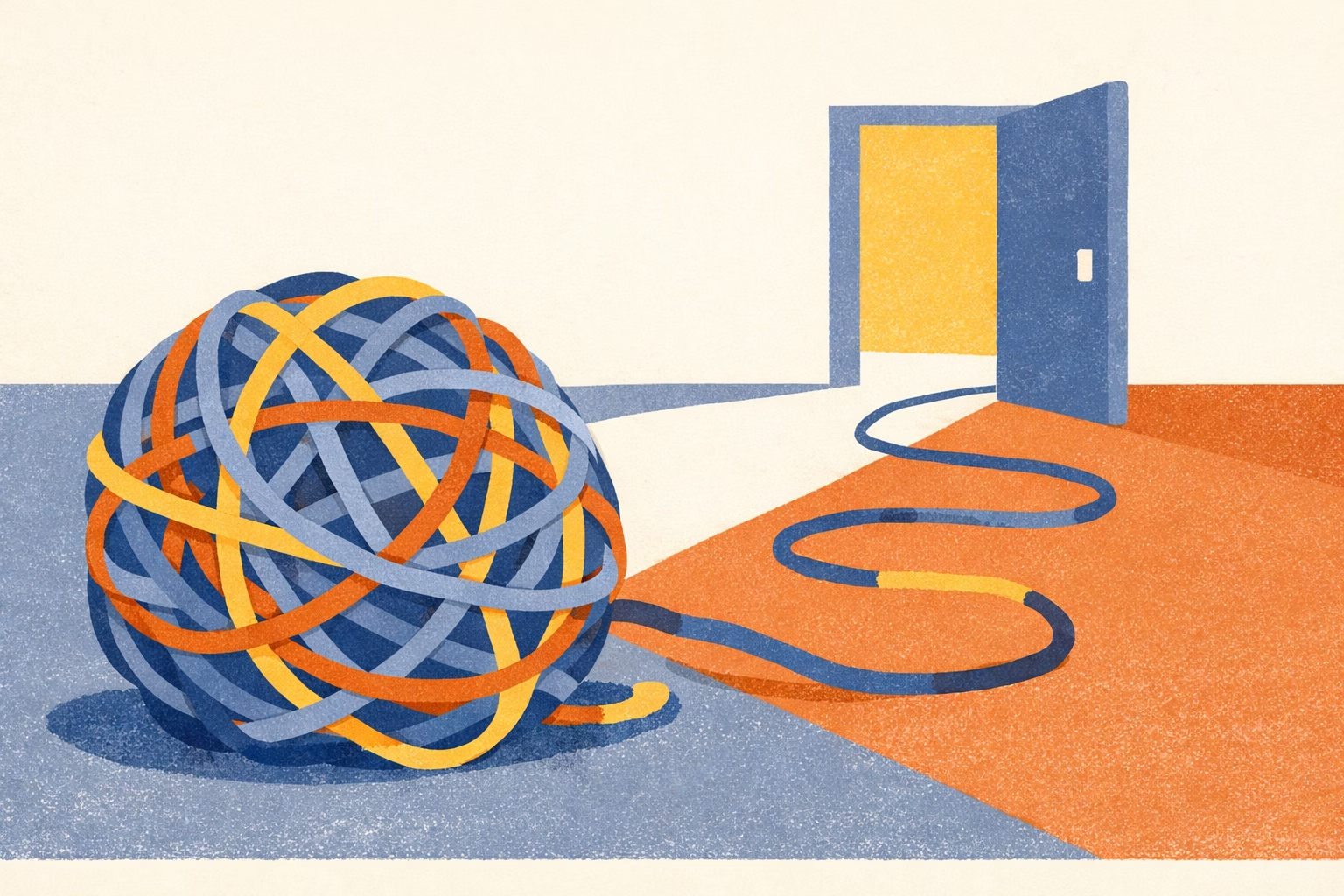
The good news embedded in everything above is this: if the loop is learned, it can be unlearned. The brain formed these connections, and the brain can be guided to revise them.
Cognitive Behavioural Therapy (CBT) has the strongest evidence of any psychological intervention for tinnitus distress. A Cochrane review of 28 randomised controlled trials involving 2,733 participants found that CBT reduced tinnitus quality-of-life impact with a standardised mean difference of -0.56 compared to no treatment, and by around 5.65 points on the Tinnitus Handicap Inventory compared to standard audiological care (Fuller et al. (2020)). CBT works on the loop by targeting the cognitive and emotional channels together: through thought monitoring, cognitive reappraisal of catastrophic beliefs, and graded exposure to situations that provoke tinnitus-related anxiety. Reducing the threat appraisal of the sound is the specific mechanism through which distress decreases (Cima et al. (2017)).
The Cochrane review rated CBT’s effect on anxiety specifically as very low certainty. A more recent meta-analysis of internet-based CBT programmes — covering 9 RCTs — found significant reductions in both GAD-7 anxiety scores (mean difference -1.33) and HADS-Anxiety scores (mean difference -1.92) compared to controls (Xian et al. (2025)). The picture across both reviews is that CBT addresses tinnitus distress solidly, and likely reduces comorbid anxiety at the same time.
Acceptance and Commitment Therapy (ACT) takes a related but distinct approach. Where CBT focuses on changing the content of anxious thoughts, ACT targets the struggle with the sound itself — developing psychological flexibility and reducing the effort spent trying to suppress or control the tinnitus experience. For many people, the exhausting work of trying not to hear the sound is itself a major source of distress.
Mindfulness-based approaches have an RCT behind them specifically for tinnitus. An RCT of 75 people found that Mindfulness-Based Cognitive Therapy produced significantly greater reductions in tinnitus severity than intensive relaxation training, with an effect size of 0.56 at six months (McKenna et al. (2017)). The treatment worked regardless of tinnitus loudness, duration, or degree of hearing loss — further evidence that distress is driven by the loop, not the sound.
Sound therapy addresses the physiological channel indirectly by reducing the perceptual contrast between the tinnitus signal and the acoustic environment. When there is more background sound, the brain’s threat-detection system has less reason to flag the tinnitus as an anomaly. This does not break the loop on its own, but it can lower the baseline activation level that keeps the other channels running.
Addressing anxiety and tinnitus together produces better outcomes than treating either in isolation. Self-help options are available: accredited internet-based CBT programmes have shown significant effects in meta-analyses and are a realistic starting point if specialist services have a waiting list.
A realistic first step for most people is a conversation with their GP about a referral for tinnitus-specific CBT or a combined audiological and psychological assessment. Internet-based programmes are a lower-barrier alternative worth discussing if face-to-face services are not immediately accessible.
The Loop Can Be Broken
Three things are worth taking away from everything above.
First: tinnitus distress is driven by the anxiety-hypervigilance loop, not by how loud the sound is. Understanding this reframes the whole problem. You are not failing to cope with an unbearable sound — you are caught in a learned brain response that can be changed.
Second: the loop runs through emotional, physiological, and cognitive channels simultaneously. All three are targetable. None of them requires you to simply try harder or worry less.
Third: CBT has the strongest evidence for breaking the loop, and self-help options exist if specialist care is not immediately available. Your brain formed this pattern, and your brain can be guided to a different one.
The next concrete step is a GP appointment. Ask specifically about a referral for tinnitus-focused CBT, or ask whether an accredited internet-based programme might be appropriate. That conversation is where the loop begins to loosen.